
Production & Print
One Design, Multiple Products: Why You Need Different Production Files
By Monk Vector Works · October 6, 2026 · 3 min
Reviewed / updated: October 6, 2026
About the team behind this guide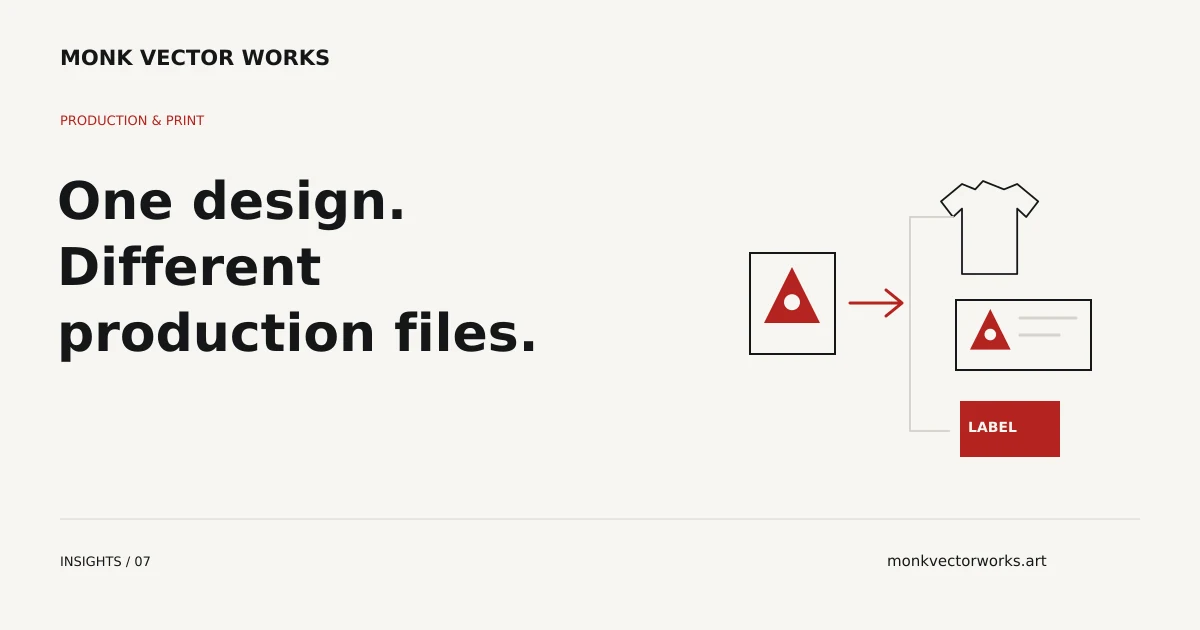
An approved design is a starting point, not a universal production file. A logo used on a shirt, acrylic sign and product label may need different dimensions, construction and exports for each supplier.
Production artwork adaptation preserves the approved visual direction while preparing the specific versions each application needs. It is particularly useful when one campaign or brand must move across several products.
Understand what changes between applications
The printable area, viewing distance, material and production method can all change. A small label needs legible text within a restricted space. A cut sign needs usable paths. A shirt may need different contrast on light and dark fabric.
The underlying design can stay recognizable while details are adjusted with approval. Those adaptations should be deliberate rather than hidden inside a file conversion.
Build an application matrix
| Application | Information to provide |
|---|---|
| Apparel | Garment color, print area and selected print method |
| Signage | Final size, material and production instructions |
| Packaging or labels | Current template, variants and supplier specifications |
| Promotional product | Supplier template, imprint area and permitted colors |
Add a delivery format for each item. If two suppliers ask for a PDF, their specifications may still differ. Confirm whether they require vector shapes, spot colors, image resolution, bleed or other settings.
Keep design decisions separate from technical corrections
“Preserve the approved logo and lettering” is a useful instruction. “Make any changes needed” can leave too much uncertainty about what is allowed. Identify which elements are fixed and which may be simplified if a production constraint requires it.
For a hypothetical company launch, the same graphic could become a full-color label, a single-color uniform mark and an engraved plaque. The deliverable set should list those three versions, with a visual proof for any changed treatment.
Organize the files for supplier handoff
Use filenames that identify the product, size, version and purpose. Keep approval previews separate from final production exports. A folder named “final” with several competing versions makes it difficult for a supplier to know which file is authorized.
If a supplier changes its specification after approval, treat the replacement export as a controlled update. Record what changed and withdraw the outdated file from the handoff.
Request the complete adaptation set
Send the approved source artwork and a list of products, sizes and suppliers. Include each supplier's instructions and the deadline for its files. Monk can quote production artwork around that defined set.
If the visual concept still needs development, start with graphic design. If the main requirement is a technical check before a print run, consider prepress.
From guidance to your project
Production artwork is the work between an approved design or customer file and the files required to move the job forward.
Explore Production Artwork servicesExplore Production Artwork
Send your artwork, intended print process and required dimensions. We’ll confirm the preparation scope and quote.