
Web & Digital
Landing Page or Full Website: Which Does Your Business Need?
By Monk Vector Works · October 6, 2026 · 3 min
Reviewed / updated: October 6, 2026
About the team behind this guide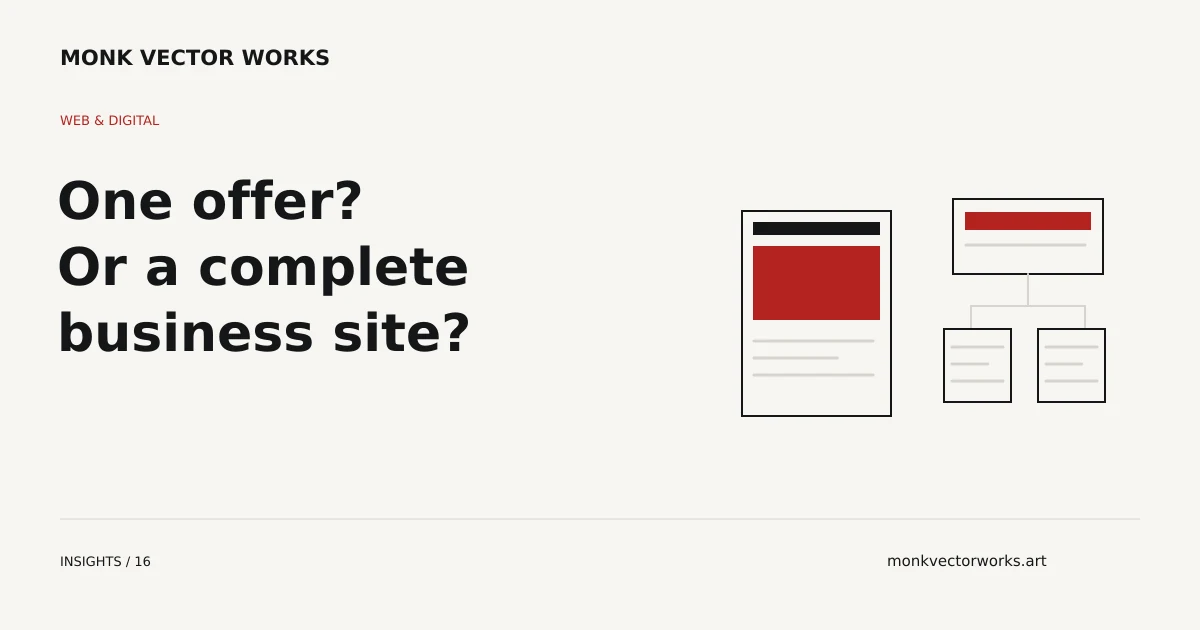
A landing page suits a focused offer and one main action. A multi-page website suits a business that needs to explain several services, establish broader credibility or maintain a growing content library. The right choice depends on the visitor's task, not the number of pages you can afford to fill.
Start with what people need to understand before contacting or buying from you. Then decide how much structure those questions require.
When a landing page is a sensible start
A focused campaign, event, product launch or clearly defined service may work well on one page. The visitor arrives with a particular question and the page guides them toward a relevant inquiry, booking or other action.
That page still needs a clear offer, useful evidence, practical details and a working contact route. Reducing the page count does not remove the need for good content or a trustworthy presentation.
When a full website fits better
Several distinct services may need their own explanations and conversion paths. A business may also need work examples, company information, resources and a blog. Putting everything into one long page can make navigation and future updates awkward.
For a hypothetical business offering three unrelated services, separate service pages let each visitor reach the relevant scope and examples. A dedicated campaign landing page can still sit alongside the main site later.
Compare the planning requirements
| Decision | Landing page | Multi-page website |
|---|---|---|
| Main purpose | One focused offer or campaign | A wider business presence |
| Content structure | One guided sequence | Several linked journeys |
| Service explanations | Limited, closely related scope | Dedicated pages where needed |
| Ongoing publishing | Usually less central | Can support articles and resources |
Neither format guarantees leads or search rankings. Organic acquisition depends on useful, accessible content and how well it matches real searches, alongside other factors. A page count alone is not an SEO strategy.
Include the work behind the launch
Confirm who supplies copy, photography and brand assets. Ask about mobile behavior, forms, analytics, redirects from an existing site and the publishing workflow. If you need to edit content yourself, include those administration needs in the scope.
Specify which integrations are essential and who controls the domain, hosting and third-party accounts. Maintenance and future changes should be discussed before launch rather than assumed to be included indefinitely.
Request a site around your actual offer
Send your services, audience, main visitor action, existing website and examples of the content you need to publish. Explain whether this is a campaign launch, a replacement site or your first business website.
Monk can scope website design around the appropriate structure. If visitors must log in and manage records or workflows, systems and web apps may be a separate requirement.
From guidance to your project
Institutional websites and landing pages that connect brand, content and clear user journeys, with responsive design and a defined launch process.
Explore Website Design servicesExplore Website Design
Send your artwork, intended print process and required dimensions. We’ll confirm the preparation scope and quote.